
A newly planted tree arrives with more branches than it needs. The task in the early years is to select a small number of well-placed limbs that will carry the canopy, and to remove or shorten the rest before they thicken into permanent problems.
Start with the central leader
Most garden fruit trees are trained around a single dominant vertical stem — the central leader. Identify the strongest, straightest upright shoot and treat it as the spine of the tree. Competing shoots that try to rival the leader in height are shortened or removed so the tree keeps one clear top.
Where two upright stems of similar strength form a narrow V, one should go. A tight, acute fork traps bark between the stems and creates a weak union that can split under fruit load or wind years later.
Choose and space the scaffold branches
The scaffold branches are the main limbs that grow directly from the trunk and define the crown. A few well-spaced scaffolds are far better than many crowded ones.
- Vertical spacing: select scaffolds at staggered heights up the trunk rather than clustered at one point, so each has room and light.
- Radial spacing: aim for limbs that point in different directions around the trunk, avoiding two strong branches stacked directly above one another.
- Angle: favour wide-angled limbs and remove or reposition narrow, upright competitors.
What to remove early
Three categories of growth are worth removing while still small:
- Competing leaders — second upright stems challenging the main one.
- Crossing and rubbing branches — limbs that touch will wound each other over time.
- Water shoots and low suckers — vigorous vertical shoots and growth from the rootstock below the graft union.
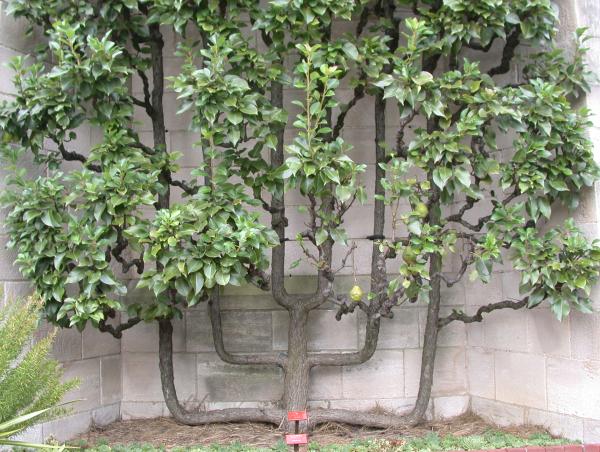
Formative priorities
- First
- Keep one clear central leader.
- Second
- Select 3–5 well-spaced scaffold branches.
- Third
- Favour wide branch angles over narrow forks.
- Restraint
- Remove less than you think; let the tree build leaf area.
Patience over the first seasons
It is tempting to cut hard on a young tree, but heavy removal of leafy growth slows establishment. The young tree needs leaf area to build roots and trunk. Make a few decisive structural choices each year, then let the tree grow. Good crown formation is the sum of small, early decisions rather than one dramatic intervention.
References
- Royal Horticultural Society — tree training and formative pruning: rhs.org.uk
- U.S. Department of Agriculture, Forest Service — guidance on tree structure and pruning: fs.usda.gov